
Chemical Storage and Handling: Safety Best Practices
Safe chemical storage starts with the current product label, safety data sheet and the rules that apply to the chemicals, quantities and site.
The practical answer
What is safe chemical storage and handling?
Safe chemical storage means keeping products secured, correctly labelled, separated by compatibility, protected from spills and environmental release, and handled using the controls specified by the label, safety data sheet and local rules.
The correct store design, PPE and emergency equipment depend on the actual products, hazards, quantities and site. There is no single global setback, bund size, temperature limit or PPE specification that is safe for every chemical store.
Identify the stock
Maintain an accurate inventory, current labels and SDS, including quantities, hazards and storage conditions.
Control the risks
Apply security, compatibility segregation, containment, ventilation, fire controls and task-specific PPE.
Prepare for failure
Plan for leaks, exposure, fire, extreme weather, unwanted stock and emergency responder access.
Start with the rules that apply to your store
Good storage advice has a clear order of authority. A generic checklist can help you inspect a store, but it cannot override a product direction or a legal requirement.
| Source | What it controls | How to use it |
|---|---|---|
| Label and permit | Approved storage, handling, PPE, first aid, disposal and use directions. | Use the current label for the exact product and jurisdiction. |
| Safety data sheet (SDS) | Hazards, incompatibilities, exposure controls, firefighting and spill information. | Keep the current version accessible to workers and emergency responders. |
| Local law | Workplace, pesticide, environmental, fire, building, waste and dangerous-goods duties. | Check thresholds for the products, quantities and site—not just the country. |
| Qualified design | Containment, ventilation, hazardous areas, firewater and electrical systems. | Use a competent adviser where the stock or site needs engineered controls. |
| Stewardship program | Collection or recycling of eligible unused products and containers. | Confirm acceptance criteria before preparing or transporting material. |
Practical chemical-store inspection checklist
Walk through the store with the inventory, labels and SDS in hand. Correct small housekeeping issues promptly; isolate damaged stock or stop work when the risk cannot be controlled safely.
- Inventory: Does the recorded stock match the products, quantities and storage locations actually present?
- Information: Are labels legible and current SDS available, including when power or internet access is lost?
- Security: Is access restricted from children, visitors, animals and anyone not trained or authorised?
- Containers: Are packages upright, closed, stable and free from corrosion, swelling, cracks or leaks?
- Segregation: Are incompatibles separated using label and SDS information rather than broad labels such as “herbicide” or “fungicide”?
- Protection: Are food, feed, seed, drinking water, drains, soil and surface water protected from contamination?
- Store controls: Do containment, ventilation, lighting and fire controls match the hazards and quantities present?
- Emergency access: Can responders identify the store, reach it safely and obtain inventory and contact information without entering?
- Response equipment: Do the spill materials, first-aid provisions and PPE match credible incidents involving the actual stock?
- Unwanted stock: Are expired, cancelled, damaged or unidentified products isolated and moving toward an authorised disposal route?
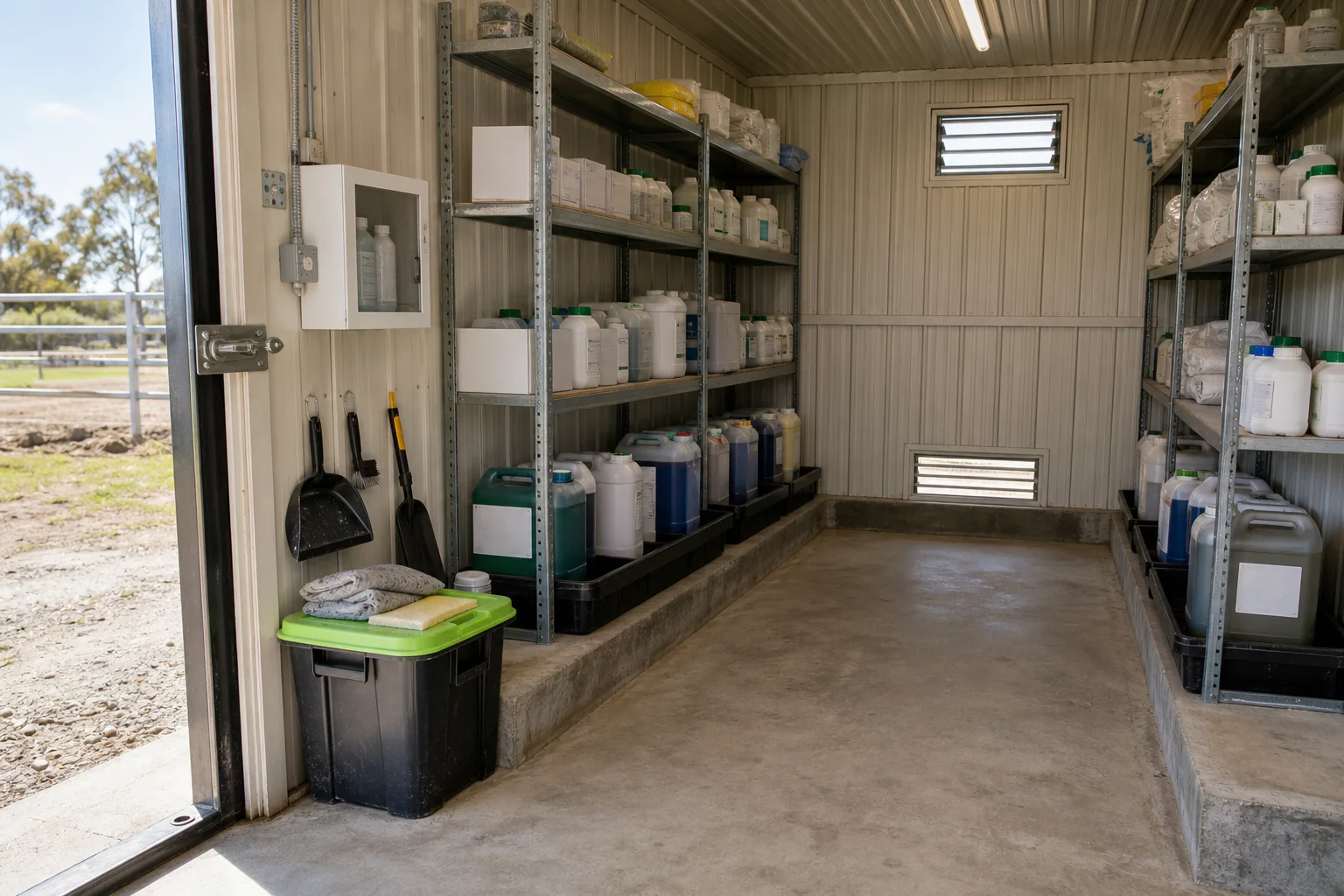
Store design and organisation
Choose a site by risk, not a universal distance
A chemical store should be secure, weather-resistant and located where a leak, flood or fire is less likely to harm people, animals, food, feed, wells, drains or surface water. Delivery vehicles and emergency services also need safe access.
Do not copy a setback from another country or property. Required distances can depend on planning rules, drinking-water protections, flood risk, fire separation, chemical classification and quantity. Confirm the applicable rule before building or relocating a store.
Segregate by compatibility and hazard
Products with similar uses are not necessarily safe together. Read each SDS—especially the handling and storage, stability and reactivity, and firefighting sections—and create a documented compatibility plan.
- Separate incompatible acids, alkalis, oxidisers, flammables and water-reactive materials as directed.
- Keep liquids below dry formulations where practical, so a leak cannot contaminate powders or granules.
- Store heavy containers where they can be handled without overreaching or climbing.
- Isolate leaking, unidentified or badly damaged packages without creating a more dangerous transfer.
- Do not treat fertilisers, fuels, fumigants, compressed gases, veterinary medicines or cold-chain products as ordinary packaged pesticides; they may activate different controls.
Contain releases without creating a new hazard
Floors, shelves and secondary containment should resist the chemicals stored and prevent a release reaching soil, drains or water. The necessary capacity may depend on the largest container, total stock, rainfall, firefighting water and local thresholds. One percentage cannot be applied safely everywhere.
Containment must also preserve safe access and keep incompatible products apart. Have a qualified person assess bulk tanks, high-hazard stock, groundwater-sensitive sites, drainage changes and firewater retention.
Match ventilation, electrical and fire controls to the stock
Ventilation should prevent harmful accumulation without directing contaminated air toward occupied or sensitive areas. More airflow is not automatically better, and ordinary electrical equipment may be unsuitable where flammable atmospheres can occur.
Fire detection, extinguishers, water supply and responder tactics depend on the products and building. Obtain local fire-authority or competent advice rather than specifying an extinguisher by a generic weight. Keep ignition sources out where required and make emergency information available outside the hazard area.
| Question | What determines the answer? |
|---|---|
| How far from water or buildings? | Local planning, environmental and fire rules; topography; drainage; flood risk; stock and quantity. |
| How large should containment be? | Chemical compatibility, container and total volumes, rainfall, firewater and jurisdiction-specific thresholds. |
| What temperature is acceptable? | The product label and SDS, formulation stability, packaging and local climate. |
| Which extinguisher or fire system? | Fire classification, stock, building, local code and advice from the fire authority or a competent designer. |
| Which gloves or respirator? | Product label, SDS, task, exposure route, duration, breakthrough data and the respiratory-protection program. |
Safe handling, PPE and transport
Handling risk changes between receiving a sealed package, decanting concentrate, mixing, cleaning equipment and responding to a leak. Select controls for the task rather than declaring one “minimum PPE” set for all chemical work.
- Before work: Confirm the product, task, label, SDS, equipment condition, emergency method and authorised operator.
- PPE selection: Follow the label first, then confirm material compatibility, fit and limitations using the SDS and manufacturer information.
- Respirators: Use only within a compliant respiratory-protection program that covers selection, medical suitability where required, fit testing, facial seal, cleaning and cartridge change-out.
- Decanting: Avoid unnecessary transfer. Never use food or drink containers, and apply the correct secondary-container identification rules.
- Mixing: Use the label sequence and application-equipment instructions; there is no safe universal mixing order.
- After work: Prevent contaminated PPE and clothing from exposing vehicles, homes, food or other people; clean or dispose of it as directed.
- Transport: Treat road transport separately from storage. Load restraint, segregation, documentation, placarding and quantity thresholds may apply.
Spill response and emergency planning
A useful plan defines what trained workers may handle and when they must withdraw and call specialists. It should cover exposure, leak, fire, theft, flood, storm damage, power failure and loss of ventilation where relevant.
- Recognise: Identify the product only from a safe position and check for fire, reaction, vapour, injured people and threatened drains or water.
- Protect: Raise the alarm, isolate the area and keep people upwind. Use PPE only when the plan and information support safe entry.
- Escalate: Contact emergency services, poison information, environmental authorities or a specialist contractor when the trigger in the plan is met.
- Contain: Stop the source and protect drains only when trained, equipped and safe to do so. Do not add neutralisers unless product-specific guidance permits it.
- Recover: Collect contaminated absorbent, soil, wash water and damaged packaging for an authorised waste decision.
- Report and review: Complete required notifications, record the incident and correct the underlying cause before reopening the area.
The spill kit should be designed from credible scenarios for the stock—not a generic shopping list or arbitrary absorbent weight. Locate instructions and responder information where they can be reached without entering the store.
Containers, unwanted products and waste
Keep products in their original labelled packages wherever possible. If a damaged package must be overpacked or material must be transferred, use a compatible, closable container and follow the local identification and labelling rules. Never place pesticides in beverage, food or feed containers.
Do not assume every container must be triple-rinsed, punctured or recycled. The product label, container type and local collection program determine preparation. Some containers are returnable, some products should not be rinsed, and hazardous residues may require licensed disposal.
- Identify unwanted stock before moving it and keep the original label with the product.
- Confirm that a collection program or waste contractor accepts the exact product and container.
- Do not pour residues, rinsate or spill waste into drains, water or onto land unless an approved direction explicitly allows the method.
- Document transfers, disposal receipts and any regulated waste movement.
Jurisdiction quick guide
The following sources are starting points, not complete legal determinations. State, provincial, territorial, member-state and local rules may add duties.
| Jurisdiction | Primary framework | Practical check |
|---|---|---|
| USA 🇺🇸 | EPA-approved pesticide labelling, federal container and containment rules where applicable, plus state and local requirements. | Start with the exact product label and EPA guidance on storing pesticides safely. Check the state pesticide and fire authorities. |
| Australia 🇦🇺 | APVMA-approved labels, state or territory control-of-use law, WHS hazardous-chemical duties and environmental, fire and dangerous-goods rules. | Check the APVMA label and your jurisdiction’s implementation of the hazardous chemicals model code. |
| UK 🇬🇧 | Pesticide authorisation and label conditions, COSHH and related environmental, fire and store requirements. | Use HSE’s AIS16 pesticide storage guidance for professional-use stores and confirm whether its scope fits your site. |
| Canada 🇨🇦 | Federal Pest Control Products Act label requirements, with provincial, territorial and local storage, fire, workplace and environmental rules. | Follow the label and Health Canada’s guidance on how to use pesticides safely, then verify provincial requirements. |
| New Zealand 🇳🇿 | Hazardous-substances controls activated by classification and quantity, including inventory, emergency planning and secondary containment. | Check WorkSafe guidance for your inventory, emergency plan and secondary containment. |
| EU 🇪🇺 | EU pesticide and worker-protection framework implemented through member-state rules, authorisations and labels. | Directive 2009/128/EC requires safe storage and handling measures, but obtain the operational rules from the relevant member state. |
Records, inspection and training
Records should make the chemical system understandable during normal work and an emergency. The necessary retention period depends on the record type and jurisdiction, so do not apply one period to every document.
- Inventory or register: Product identity, quantity, location and hazard information.
- Safety information: Current labels and SDS, with obsolete versions controlled where necessary.
- Inspections: Container condition, containment, security, emergency equipment and corrective actions.
- Competency: Induction, product and task training, licences, respirator requirements and supervision.
- Movements: Purchases, transfers, transport documents, waste collections and disposal receipts where required.
- Events: Exposure, spill, fire, theft, notification, investigation and follow-up.
- Applications: The separate field-use record required by the label, permit, law, customer or assurance scheme.
Where Spraybook fits
Spraybook can help you create structured spray-application records with products, rates, locations, equipment, weather, notes and supporting photos. That makes the use history easier to retrieve and export.
Spraybook does not replace a chemical-store inventory, product label or SDS, workplace risk assessment, emergency plan, qualified store design or local legal advice. Keep those systems alongside your application records.
Key takeaway
Safe chemical storage is not a building specification copied from a generic list. It is a maintained system: know what is present, follow the controlling label and rules, separate incompatibles, prevent releases, equip and train people for their tasks, and prepare for incidents that exceed routine cleanup.
Published · Updated