
Understanding Spray Drift: Causes, Prevention, and Compliance
A practical, label-led guide to understanding off-target spray movement, interrupting the drift pathway, and responding to a suspected incident.
The direct answer
What is spray drift?
Spray drift is spray droplets or dust moving through the air away from the intended target during, or soon after, application. It can expose people, animals, crops, water and other sensitive areas that were not meant to be treated.
Particle or spray drift
Airborne droplets or dust leave the target during or shortly after application.
Vapour movement
A substance volatilises during or after application, then moves as vapour. Product volatility and label controls matter.
Runoff and drainage
Water carries residues across the surface or through drainage after deposition. This is not airborne spray drift.
Other transfer
Contaminated equipment, dust, soil, plants or people can move residues by different pathways requiring different controls.
Cause-to-consequence pathway
Where drift control can interrupt the pathway
Source
Droplet spectrum, nozzle or atomiser, pressure, formulation, release height and equipment condition.
Control the sprayAirborne transport
Wind speed and direction, gusts, evaporation, atmospheric stability and time aloft.
Control the windowOff-target exposure
People, neighbouring crops, pollinators, livestock, homes, roads, water and habitats downwind.
Separate and protectConsequence
Exposure, crop injury, environmental harm, complaints, investigation or loss of application efficacy.
Stop, preserve, reportA buffer acts late in this pathway. It does not replace a permitted use, the required spray quality, suitable weather, correct release height or a decision to stop.
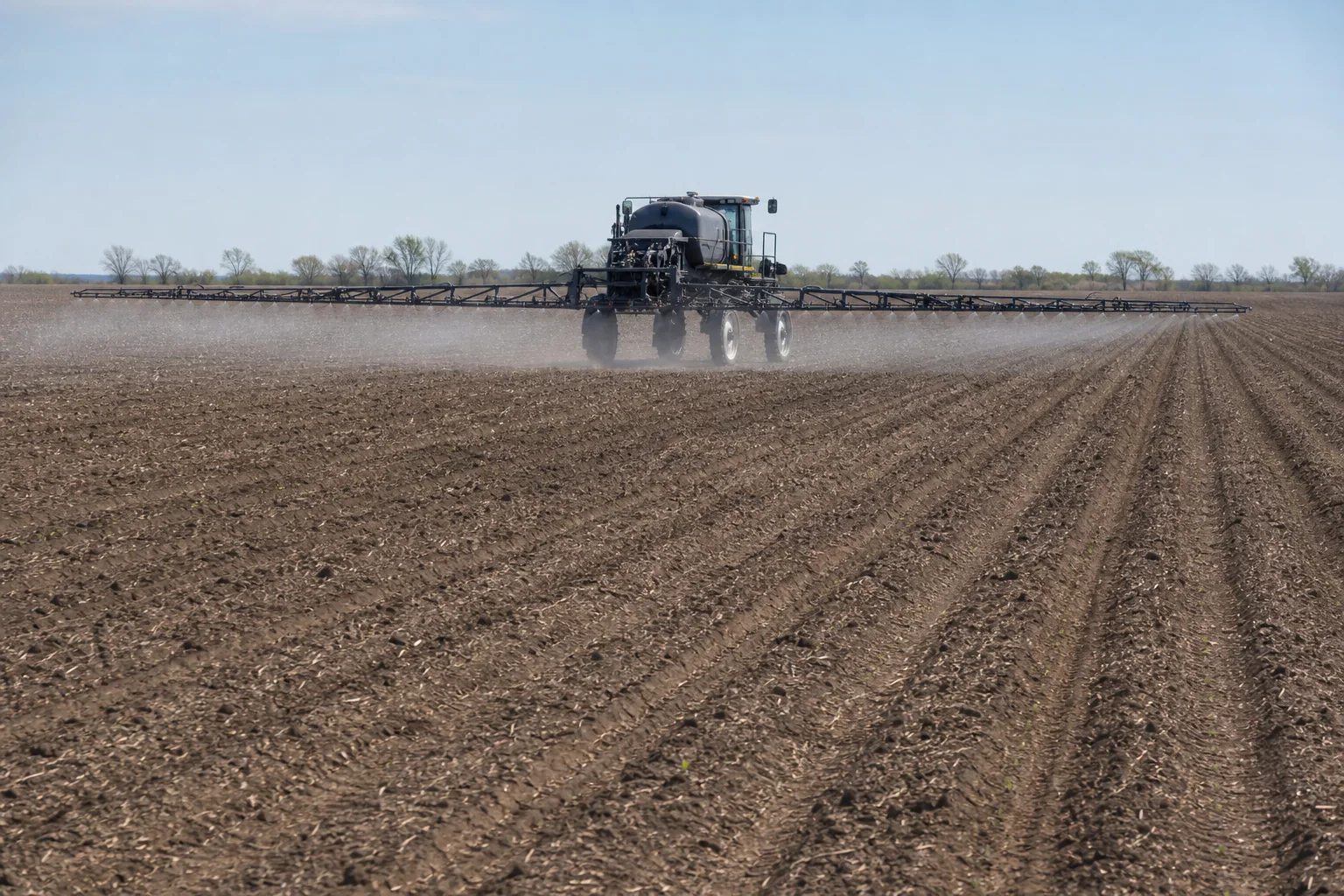
Control hierarchy
Prevent first; mitigate what remains
Controls are cumulative. A late control cannot cancel a failure earlier in the pathway.
- 1Avoid the pathway
Confirm the use, map receptors, change the treatment edge or wait when the pathway cannot be controlled.
- 2Control the source
Meet spray quality, height and equipment requirements; inspect and calibrate the actual setup.
- 3Reduce transport
Work inside label weather restraints and maintain every mandatory buffer or no-spray area.
- 4Monitor and stop
Recheck changing conditions and stop for a limit, receptor, fault or visible off-target movement.
- 5Respond and learn
Protect health, preserve accurate information, notify as required and review before resuming.
Buffers are backstops, not permission: they do not make a prohibited use, unsuitable weather or incorrect spray quality acceptable.
Interactive control planner
Find what still needs to be resolved
Select the status that best describes this job. The planner organises checks; it does not calculate drift, interpret the label or say that spraying is safe or legal.
Planning status
Resolve seven controls before making the application decision
Every control is currently marked for review. Start with the current product label and the actual downwind receptors.
- None selected
- Product and label
- Spray quality and setup
- Release height
- Weather and inversions
- Buffers and boundaries
- Sensitive receptors
- Monitoring and stop plan
Final check: use the current label, permit and local rules. “Confirmed” here is your own planning note, not an approval from Spraybook.
The first control is the current label
No website can give one wind range, droplet category, Delta T range, release height or buffer that makes every application acceptable. The product, crop or site, application method, jurisdiction, equipment and conditions change the answer. In the United States, EPA-approved pesticide labelling is legally enforceable and can specify droplet category, release height, wind limits and buffers. US EPA: Introduction to pesticide labels and drift label instructions (accessed 1 August 2026).
Start by finding the current label and any permit, state or local control that applies to the exact use. Extract the constraints before choosing the nozzle, pressure, water volume, speed, height or spray window. Guidance can help you satisfy those constraints; it cannot overwrite them.
What makes airborne drift more likely?
Particle drift is not caused by one setting. It is the result of a droplet spectrum being released into moving air for long enough to reach somewhere off-target. The important controls interact.
Droplet spectrum—not one average diameter
A nozzle produces a range of droplet sizes. The smaller part of that spectrum has less mass, remains airborne longer and is more vulnerable to wind and evaporation. Coarsening the spectrum can reduce drift, but “coarser is always better” is not a complete application decision: the product label may require a spray-quality category, and target coverage or efficacy can change with product, formulation and canopy.
Health Canada explains that its labels specify spray quality, while the applicator selects the nozzle, flow, pressure and speed that achieve it. It also warns that some low-drift nozzle choices may not suit some contact products, so the label must remain the reference. Health Canada: Management of pesticide spray drift (accessed 1 August 2026).
Nozzle, pressure, mixture and speed work as a system
- Nozzle or atomiser: type, orifice and orientation influence the droplet spectrum and pattern.
- Pressure: changing pressure can change flow, pattern and droplet spectrum; remain within the nozzle manufacturer’s operating range and the label-required spray quality.
- Formulation and adjuvants: the actual tank mixture can atomise differently from water. Use only permitted, compatible products and do not assume the word “drift” on an adjuvant replaces a verified setup.
- Travel speed: speed changes required flow and can affect boom movement, height and air shear. Re-select and calibrate the setup rather than using speed alone to recover work rate.
- Wear or blockage: damaged, worn or partially blocked nozzles can alter output and pattern, so inspection and calibration are part of drift control.
USDA Agricultural Research Service work demonstrates why equipment claims should be specific: nozzle and operating-condition combinations produced materially different droplet spectra and modelled drift in standardised testing. Those results compare tested systems; they are not a universal reduction claim for every mixture or field. USDA-ARS: Standardised spray-drift reduction evaluations (Hoffmann et al., 2010).
Release height adds time aloft
Increasing the distance from release point to target gives wind and evaporation more time to act. Keep a boom or nozzle only as high as needed to maintain the correct overlap, pattern and clearance, while meeting the label and equipment instructions. A fixed height copied from another boom, nozzle angle, aircraft or canopy is not a reliable rule. UK HSE guidance similarly recommends keeping a boom as low as possible consistent with an even pattern at the correct target height. HSE: Reducing spray drift (updated 7 October 2025).
Wind direction matters as much as the number
Wind determines where airborne droplets travel. A speed that falls inside a label range does not make a job acceptable if the wind is carrying spray toward people, a sensitive crop, water, livestock or another protected area. Gusts and shifts can also make an average reading misleading. Observe conditions at the application site and at a representative height, note direction relative to receptors, and keep checking during the job.
Dead calm is not automatically favourable. Stable air or a surface temperature inversion can allow a suspended spray cloud to remain concentrated and move later when the air begins to flow. Look for the indicators and measurement method specified by the label and local guidance; do not infer that an inversion is absent from clock time or one weather-app reading.
Heat, low humidity and evaporation
When evaporation reduces airborne droplets, the smaller droplets that remain can be more drift-prone. Temperature and humidity therefore matter in combination with formulation, droplet spectrum, release height and time aloft. Health Canada’s applicator summary identifies high temperature and low relative humidity as factors that can increase evaporation, but its example values are guidance in a Canadian context—not a substitute for the product label.
Delta T can help describe evaporative demand, but it cannot detect an inversion, show wind direction, identify a receptor or decide whether a label permits application.
Pre-spray drift-control checklist
Before mixing or loading
- Obtain the current label and any applicable permit, state, provincial, territory or local instructions.
- Confirm the product, target, crop or site, rate, application method and operator authorisation.
- Extract every drift restraint: spray quality, release height, wind, inversion, buffer, bystander, water, pollinator or neighbouring-crop controls.
- Inspect the treatment boundary and map downwind receptors, including temporary water, flowering vegetation, workers, roads and occupied areas.
- Decide how required buffers will be measured and which parts of the job will be left untreated if direction changes.
Before opening the nozzles
- Confirm that nozzle or atomiser, pressure, flow, speed and mixture produce the required spray quality and application rate.
- Check nozzles, filters, hoses, boom or aircraft setup, pattern, calibration and practical release height.
- Measure on-site wind speed and direction at a representative location and height; note gusts and variability.
- Assess atmospheric stability or inversion conditions using the label and local method—not time of day alone.
- Confirm that people, animals and other moving receptors are clear and that communication or notification duties are complete.
- Name stop conditions and make sure the operator can stop promptly.
During and after application
- Recheck weather and direction whenever conditions change and at sensible stages through the application.
- Watch the downwind edge, spray pattern, boom or flight height and equipment performance.
- Stop for a limit, wind shift, gust pattern, inversion indicator, receptor entry, leak, blocked nozzle or visible off-target movement.
- Record the actual start, middle and end conditions, equipment and job settings—not only a pre-job forecast.
- Note untreated areas, interruptions, changes and the reason for each decision.
How rules differ by jurisdiction
This table is a starting point for finding the responsible source, not a summary of every law. Product labels and sub-national rules can be more specific.
| Jurisdiction | What controls the application | Useful official source |
|---|---|---|
| USA 🇺🇸 | EPA-approved labelling is enforceable and may specify application method, droplet category, release height, wind and buffers. States generally lead use enforcement and may add requirements. | EPA label guide and incident reporting |
| Australia 🇦🇺 | APVMA labels can contain mandatory spray-drift restraints, droplet categories and downwind buffers. States and territories regulate use and investigate incidents. | APVMA spray drift and NSW example |
| UK 🇬🇧 | The authorised product label and PPP rules apply. Some aquatic buffer decisions use LERAP; only eligible buffers may be reduced and records are required. | HSE drift guide and LERAP |
| Canada 🇨🇦 | Follow the registered label. Eligible labelled buffers may be modified with the official calculator using actual weather and configuration; the summary record must be retained. | PMRA buffer calculator |
| New Zealand 🇳🇿 | Substance approvals, label controls, hazardous-substance rules and regional plans can apply. Certain workplace uses require records including wind and measures taken to avoid drift. | EPA NZ agrichemicals guide |
| EU 🇪🇺 | Authorisations and use controls are implemented by Member States. EU law requires measures to protect water, including preference for equipment that limits drift and measures such as appropriately sized buffers. | Directive 2009/128/EC, Article 11 |
If spray drift is suspected
Respond to the actual hazard and the local reporting rules. Do not use this checklist in place of the product’s first-aid instructions or emergency services.
- Protect people first. Stop the application if it is safe to do so. Move away from exposure, follow the label’s first-aid directions and contact emergency services, a poison centre or a health professional when required.
- Prevent further release. Secure equipment and the site without creating another exposure. Do not resume until the cause and conditions have been reassessed.
- Record observations promptly. Note time, location, wind and weather, people or areas affected, visible movement, odour and symptoms. Take photographs from a safe place. Separate what was observed from what is assumed.
- Preserve relevant information. Keep the product label, batch and mix details, application record, equipment settings, calibration information, weather readings, maps, photos and communications. Preserve physical evidence only where safe and lawful.
- Notify the right parties. Follow immediate-notification duties, regulator instructions, insurer requirements and workplace procedures. In the US, EPA routes incidents by exposure type; in Australia, the relevant state or territory normally handles use incidents. US EPA incident reporting; APVMA reporting overview.
- Do not diagnose cause from symptoms alone. Particle drift, vapour, runoff, contaminated equipment and unrelated crop stress can require different evidence. Allow the responsible authority or qualified specialist to investigate.
For example, NSW EPA asks people affected by spray drift to report it as soon as possible, while emergencies presenting an immediate threat should go to emergency services. Requirements and contacts differ elsewhere. NSW EPA: Avoiding pesticide spray drift (accessed 1 August 2026).
Keep a defensible record of the job
A useful drift record reconstructs decisions without claiming to prove where every droplet went. Capture:
- current product identity, registration number, rate, quantity and applicable label or permit;
- operator, date, start/middle/end times, location, treated area and nearby receptors;
- equipment identity and snapshot, nozzle or atomiser, pressure, water rate, speed, droplet category and release height where relevant;
- on-site wind speed and direction, gust observations, temperature, humidity and inversion assessment method;
- buffers, untreated edges, interruptions, setting changes and stop decisions;
- notes, safe photographs and any incident or regulator reference number.
Spraybook can store structured spray records with product details, an equipment snapshot, relevant job settings, start/middle/end weather, location, notes and up to five photos. Eligible records can be exported to PDF or CSV for review. These records can support traceability, but Spraybook does not detect drift, interpret labels, determine whether an application is safe or legal, or prove compliance.
Continue with the related guides to observe weather through a spray job, select nozzles and spray quality, and build a practical application record.
Review note: Chemical-use and compliance requirements change. Have this guide reviewed for the products, equipment and jurisdictions in which it will be used, and always follow the current label and responsible authority.
Published