
Weather Conditions for Safe and Effective Spraying
A practical, label-led guide to planning, checking and recording changing weather during spray application.
Direct answer
There is no universal best weather range for spraying
The usable spray window is the period when the current product label and permit allow the job, the target and equipment are suitable, local rules are met, and observations at the site remain within the job's defined limits.
Wind, atmospheric stability, temperature, humidity, rain and leaf wetness interact. A forecast can help you plan, but it cannot replace the label, on-site measurements, downwind checks or repeated observations during application.
The spray window is a sequence
Plan, observe, recheck and close the record
A spray window is not a single forecast icon or start reading. Conditions and obligations must still hold as the work progresses.
- Plan
Read the current label and permit, map receptors, check forecasts and define stop conditions.
- Start
Observe conditions at the site and application height before opening the spray.
- Middle
Recheck wind, direction, gusts, stability clues, temperature, humidity and approaching weather.
- End
Record the final observations, time and any change that altered or stopped the job.
- After
Note unexpected rain, runoff, efficacy concerns or suspected off-target movement and follow the relevant response process.
Interactive observation planner
Turn weather observations into next checks
Select the closest answer for this job. The result highlights unresolved checks and conflicts; it never gives a spray approval or safety score.
Planner status
Checks still unresolved
Work through the unresolved observations before deciding whether this job can begin.
Limit: this worksheet cannot interpret a label, detect an inversion, forecast a safe window or determine legal compliance.
Five condition checks
Read weather as a connected system
Wind
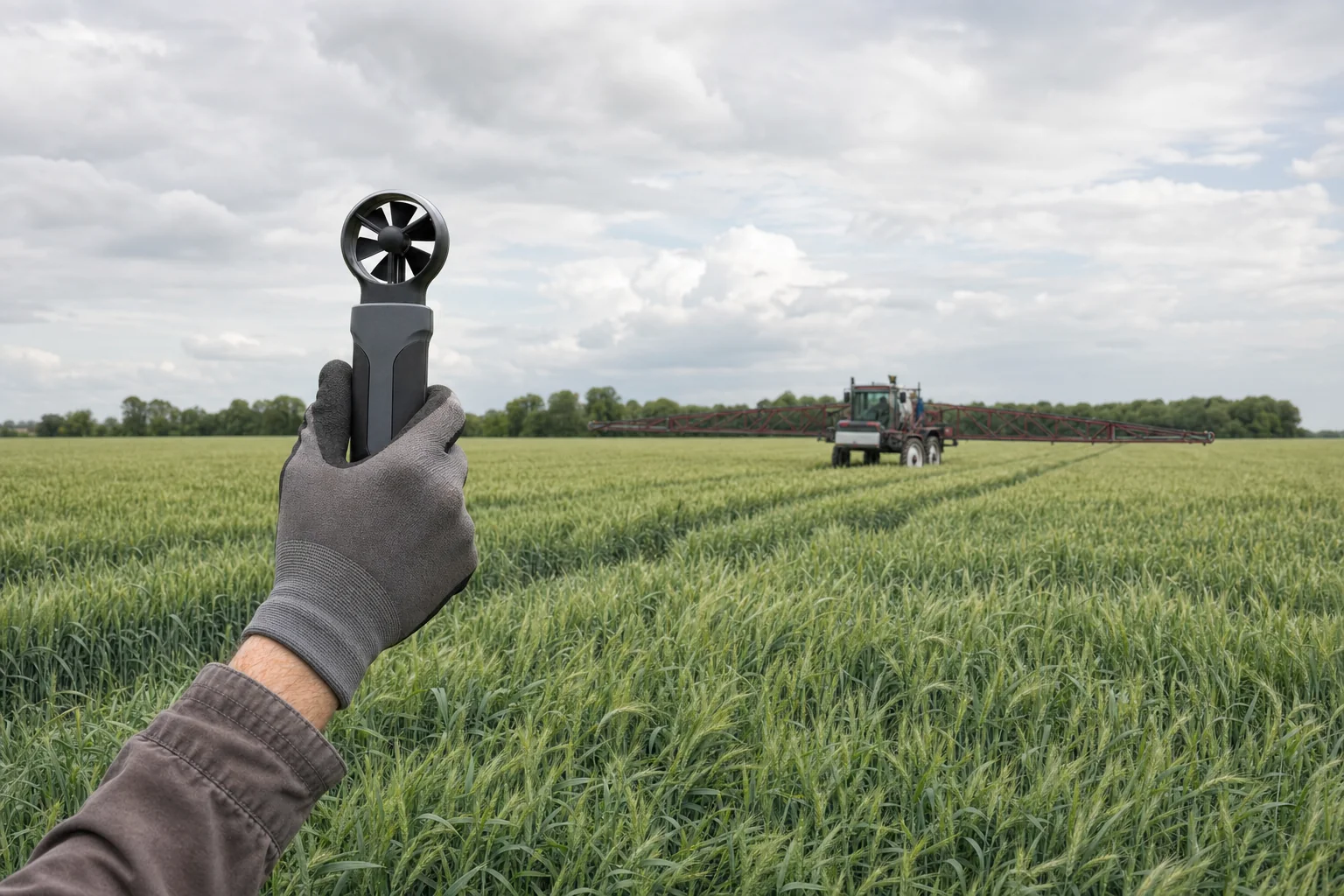
Compare speed, direction and gusts at the application site with the label. Direction determines what is downwind; an average can hide variable or gusty conditions.
Atmospheric stability
Calm air is not automatically favourable. Look for inversion evidence and follow any label or local prohibition; a weather app cannot confirm conditions at nozzle height.
Heat and humidity
Together they affect evaporation and droplet shrinkage. Their effect depends on spray quality, formulation, release height and time aloft—not a universal temperature or RH cut-off.
Rain, dew and wet foliage
Separate the rain forecast from the product's rainfast, watering-in and leaf-surface directions. Wet foliage may matter differently for different products and targets.
Rapid change
A valid start reading can become stale. Fronts, terrain flows, cloud changes and storm outflows can change wind and stability during the job.
Interaction diagram
Why one weather number cannot describe the job
These influence deposition, evaporation and off-target movement together.
A coarse spray released close to the target has a different exposure to the air than a finer spray released higher, even under the same temperature and humidity.
What makes a weather window usable?
A forecast identifies a possible period to inspect. It does not prove that conditions at a paddock, orchard, sports field or roadside meet the product directions. The final decision has to combine the current label and permit, the application method, target, equipment, nearby receptors, local requirements and observations made where the spray is released.
This distinction matters because official forecast winds are commonly defined at standard meteorological heights and exposures. For example, the US National Weather Service describes forecast sustained wind at 10 metres, while some pesticide directions require measurement at release height or another application-specific height. The EPA's mitigation guidance says that, where its measure applies, wind must be measured at release height or higher in an unobstructed area. Use the measurement method stated on the label or by the relevant authority rather than treating a phone forecast as the field reading. Compare NWS forecast definitions and EPA measurement examples.
Check the conditions in the right order
1. Start with the product, not the forecast
Read the current product label and any permit or supplemental directions. Pull out every weather-dependent instruction: wind-speed and direction limits, inversion prohibitions, required spray quality, release-height limits, buffers, temperature or humidity conditions, rainfast or watering-in directions, and restrictions protecting people, crops, water or habitats. In the United States, EPA explains that pesticide labels are legally enforceable and define how a registered product may be used. Read EPA's label overview.
2. Map the target and what is downwind
Wind direction only becomes useful when it is related to the site. Identify homes, workers, roads, schools, neighbouring crops, organic production, livestock, beehives, waterways, drains and sensitive habitat. Then work out which areas become downwind if direction shifts. Required buffers and notifications come from the label, permit and local rules; they are not replaced by a favourable wind reading.
3. Use forecasts to shortlist—not approve—a window
Review wind speed and direction, gusts, temperature, humidity, precipitation timing, thunderstorms and frontal changes across the expected job duration. Include setup and cleanup time. A narrow favourable forecast between two fast-changing systems may provide too little margin for a real application.
4. Verify the site before spraying
Observe the actual site long enough to see lulls, gusts and direction changes. Position instruments using the product or regulator's method, away from obstructions where required. Inspect the target surface and look for inversion evidence. Confirm that the intended equipment setup, droplet category, release height and buffers still match the plan.
5. Keep checking while the job moves
A start reading cannot describe the middle or end of a long job. Recheck at meaningful stages and immediately after a material change: a wind shift, gust front, cloud transition, move into different terrain, change in release height, approaching rain or a new downwind receptor. Stop criteria should be explicit enough that the operator does not have to invent them under pressure.
Measure weather where it affects the spray
| Observation | What to capture | Common blind spot |
|---|---|---|
| Wind speed | Applicable averaging method, normal variation and gusts—not only one peak or one instant. | A distant station or 10 m forecast can differ from wind at the release point. |
| Wind direction | Direction wind comes from, variability, and the receptors that are downwind. | A compass direction without a receptor map does not show consequence. |
| Atmospheric stability | Recognised monitoring and field evidence required by the label or jurisdiction. | “Calm” does not prove that a surface inversion is absent. |
| Temperature and RH | On-site readings, time and measurement location; calculate or record Delta T only when useful. | Neither reading alone describes droplet evaporation or product efficacy. |
| Rain and surface wetness | Latest forecast, visible weather, recent rain, dew or irrigation, plus the product's directions. | A generic rain-free period can contradict the actual label. |
| Change over time | Start, middle and end readings, with extra observations after a meaningful change. | One start reading may conceal the conditions present over most of the job. |
Health Canada's applicator guidance illustrates why the variables belong together: higher temperature and lower relative humidity increase evaporation, while droplet size, boom height, speed, pressure and equipment condition also affect drift potential. Its figures are Canadian guidance, not global thresholds. Read the Canadian source and its scope.
Do not confuse three different weather questions
- 🌬️ Will the spray stay on target?
Wind, stability, evaporation, droplet spectrum, release height and receptors shape airborne movement. See the separate spray drift guide for the cause-to-control pathway. - 🌿 Will the treatment work?
Product, formulation, target, growth stage, surface wetness, temperature and rain timing can influence performance. Only the product directions and appropriate technical advice can answer this for the job. - 📋 Is the job allowed?
The label, permit, law, local controls, licences and site-specific obligations determine this. Good-looking meteorology cannot override a restriction.
Temperature inversions require their own check
A surface temperature inversion occurs when air temperature increases with height, leaving cooler air near the ground beneath warmer air. The Bureau of Meteorology explains that low-level inversions can form on clear, calm nights and restrict mixing. In spray work, suspended small droplets may then move laterally in concentrated layers rather than dispersing predictably. See the Bureau of Meteorology definition.
Do not use time of day, wind speed or Delta T alone as proof that an inversion is present or absent. APVMA lists field indicators such as mist, fog, dew or frost; smoke or dust hanging and moving sideways; cool off-slope breezes; and other evening observations. The exact prohibition and recognised monitoring process must still come from the product instructions and applicable jurisdiction. Review APVMA's hazardous inversion definition and indicators.
Delta T describes evaporative demand, not atmospheric stability. The Delta T guide and calculator explains what it can—and cannot—tell an applicator.
Rain, dew and humidity are product-specific
- Rain before application: check access, soil or surface condition, foliage wetness, runoff pathways and the label's target-surface directions.
- Rain after application: use the product's rainfast or watering-in wording. Do not substitute a generic one-, four- or six-hour rule.
- Dew or wet foliage: decide whether it changes retention, dilution, runoff or uptake for the specific product and target.
- Low humidity or high evaporative demand: assess it alongside temperature, spray quality, release height and time aloft; do not use RH or Delta T alone.
- Unexpected rain: record what happened and seek product-specific advice before assuming a repeat application is needed.
The reason for avoiding a universal rainfast table is simple: EPA's label manual notes that directions may restrict use by weather, time of day or season, and APVMA says approved labels state when and how to spray for the assessed use. The answer belongs to the current product directions. US label context; Australian label context.
Weather and label guidance by jurisdiction
This table is a starting point for finding official guidance, not a substitute for the current product label or local rules. Requirements can also vary by state, province, territory, devolved nation, Member State, product and application method.
| Jurisdiction | What official guidance emphasises | Start here |
|---|---|---|
| USA 🇺🇸 | EPA labels are enforceable and can set weather, method, droplet, release-height and buffer directions. State or local requirements may add controls. | EPA pesticide labels |
| Australia 🇦🇺 | Follow the registered label or permit and applicable use controls. APVMA publishes spray-drift and hazardous-inversion definitions; state and territory law governs use. | APVMA: spraying chemicals |
| Great Britain 🇬🇧 | Take reasonable precautions to prevent drift, account for weather and protect people, wildlife and the environment. Labels and approvals give required buffers. | HSE drift guidance |
| Canada 🇨🇦 | Users must follow the Health Canada-approved label. Official drift guidance covers wind, temperature, humidity, equipment and buffer-zone records. | PMRA applicator guide |
| New Zealand 🇳🇿 | Substance controls and labels can set application restrictions. Certain professional uses require written records including wind speed/direction and drift controls. | EPA NZ agrichemicals guidance |
| European Union 🇪🇺 | EU rules establish a framework, while Member States authorise products and apply national controls. Aerial permissions may specify circumstances and weather conditions. | Directive 2009/128/EC |
A staged weather record for the whole job
| Stage | Record | Why it matters |
|---|---|---|
| Planning |
| Shows what information the operator used to define the possible window. |
| Start |
| Captures conditions before release, not just a distant forecast. |
| Middle |
| Preserves what happened after the start reading became old. |
| End |
| Closes the application record while details are still available. |
| Post-application |
| Separates the application observations from later outcomes and response actions. |
Do not invent a universal observation interval. Use any frequency specified by the label, permit, contract or regulator, and add a recheck whenever the condition, site or application setup changes materially. In New Zealand, for example, EPA guidance requires wind speed and direction in certain written application records; the trigger and full fields are jurisdiction-specific. Check the New Zealand record rules.
Keep staged weather with the spray record
Spraybook can retrieve or manually record weather at the start, middle and end of an application. A record can retain temperature, humidity, rain, wind speed and direction, cloud and Delta T, with provider and location metadata where available. Keep those weather points alongside the location, operator, equipment snapshot, products, job settings, notes and up to five photos, then create eligible CSV or PDF exports.
- Use manual readings when they better represent the instrument and location required for the job.
- Automatic retrieval requires network access; provider availability and historical coverage vary by country and service.
- Record why a job paused or ended early in notes rather than making a favourable weather reading imply approval.
- Review the exported record against the fields required by the applicable label, law, permit, contract or assurance program.
Related practical guides
- Understand Delta T without treating it as a spray recommendation
- Trace spray drift causes and controls
- Compare nozzles and droplet-size categories
- Build a complete chemical-application record
Last substantive review: 1 August 2026. Safety, pesticide-use and legal requirements should be checked with the current product label and the relevant authority or a suitably qualified adviser before application.
Published