
Understanding Delta T and Its Importance in Spraying
Delta T is the difference between dry-bulb and wet-bulb air temperature. It helps indicate how readily water may evaporate from spray droplets.
Quick answer
What is Delta T?
Delta T is the difference between dry-bulb air temperature and wet-bulb temperature. It indicates how readily the surrounding air can evaporate water from spray droplets.
Delta T is useful, but it is only one weather measurement. It does not determine by itself whether spraying is safe, legal, effective, or free from temperature inversions.
Measure the air
Take dry- and wet-bulb readings, or use temperature and relative humidity to estimate them.
Find the difference
Subtract wet-bulb temperature from dry-bulb temperature. The result is Delta T.
Check everything else
Use the label, wind, inversion status, spray quality, buffers, and site conditions for the spray decision.
Interactive worksheet
Calculate or estimate Delta T
Use direct dry- and wet-bulb readings when you have them. The temperature and relative-humidity option is an estimate for learning and comparison, not an application decision.
The estimate uses Roland Stull's published approximation, principally documented for −20°C to 50°C and 5% to 99% RH at standard sea-level pressure. Read the method and limitations.
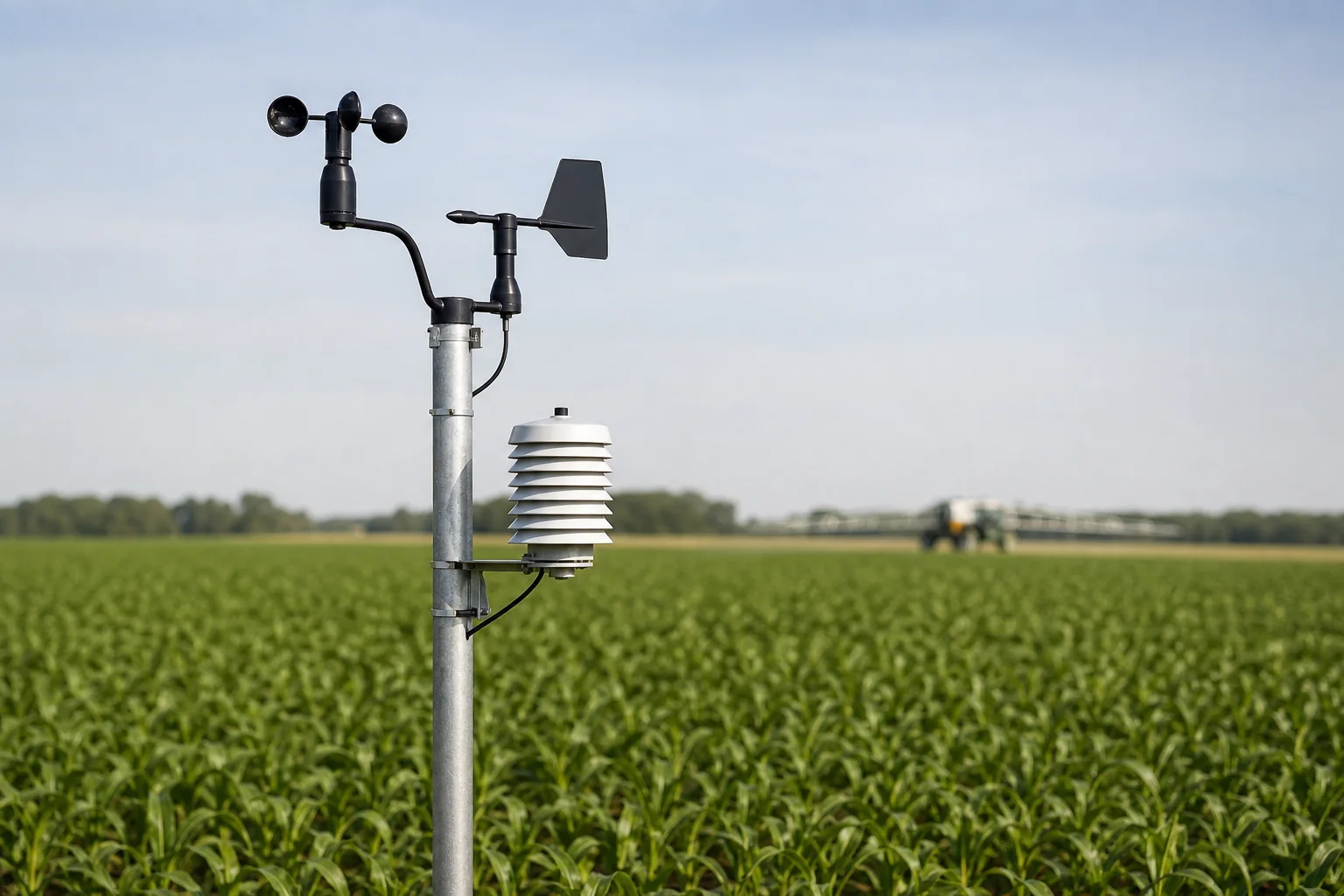
What Delta T measures
Delta T is calculated as:
Delta T = dry-bulb temperature − wet-bulb temperature
- Dry-bulb temperature is ordinary air temperature measured by an appropriately exposed sensor.
- Wet-bulb temperature is the temperature of a wetted sensor exposed to airflow. Evaporation cools the sensor, so it normally reads below the dry bulb when the air is not saturated.
The two readings converge as the air approaches saturation. A larger difference generally represents drier air with greater psychrometric drying potential. This is why Delta T is more informative about water evaporation than relative humidity viewed on its own. The GRDC technical manual on meteorological principles defines Delta T this way and uses it as an estimate of the evaporation potential of the aqueous component of a spray.
Delta T is also called wet-bulb depression. It is not dew point, “feels like” temperature, natural wet-bulb temperature or wet-bulb globe temperature used for heat-stress assessment.
Use Delta T as one decision input
The most useful question is not “Is this Delta T safe?” but “What does this reading answer, and what must I check separately?”
| Decision question | Can Delta T answer it? | Evidence to use |
|---|---|---|
| Is ambient evaporative demand elevated? | Yes, approximately | Dry- and wet-bulb readings, or temperature, RH and pressure with a documented calculation |
| Is this application permitted under the current conditions? | No | Current product label, permit and applicable law |
| Is a hazardous surface-temperature inversion present? | No | Vertical temperature information, validated field indicators and the label or regulator’s instructions |
| Will droplets shrink enough to become drift-prone? | Not alone | Delta T plus droplet spectrum, formulation, release height, airflow, wind and flight time |
| Is the crop or target surface too hot? | No | Direct surface or canopy measurement and product-specific guidance |
| Will the product remain effective? | No | Label, product research, plant condition, coverage and post-application weather |
Actual airborne droplet behaviour depends on interacting factors including nozzle and pressure, initial droplet-size spectrum, formulation, non-volatile content, release height, sprayer wake, relative airflow, wind, turbulence and time aloft. Research on deposited droplets also shows that relative humidity, droplet size, formulation and the leaf surface change evaporation and coverage, so Delta T is not a direct forecast of what will happen to every formulated droplet. See the USDA Agricultural Research Service study of pesticide droplets on hairy and waxy leaves.
How Australian Delta T guidance should be read
Different sources use different ranges because they are addressing different spray qualities, products and outcomes. A band intended to manage evaporation for a medium spray is not automatically suitable for a coarse spray or for product uptake.
| Source | How it treats Delta T | Status |
|---|---|---|
| GRDC Practical Tips for Spraying (2025) | Calls 2–8°C a common guideline, advises caution below 2°C and above 10°C, and says to avoid values above 12°C. | National extension guidance, not legislation or a product label |
| GRDC Weather Essentials grower edition (2022) | Describes 2–10°C as a common guideline and flags caution at the low and high ends. | Practical extension guidance |
| GRDC technical manual (2022) | Restricts medium or finer spray quality to 2–8°C in its guidance; discusses extension to 12°C for coarser applications only with demanding operational controls. | Conditional technical guidance |
| Agriculture Victoria | Lists 2–8°C alongside wind and inversion conditions as a preferred practical window. | Victorian extension guidance, not a national legal threshold |
| Current product label, permit and applicable law | May impose product-specific directions or other weather, droplet, inversion and buffer restraints. | Controlling requirements: check before and throughout the job |
Product-specific Delta T wording does exist. For example, an APVMA public-release summary for Katana 250 WG included a 2–8°C direction in critical comments. That historical regulatory document shows why a product-specific direction should not be mistaken for a universal rule. Verify the current approved label in the APVMA product database before relying on its present wording.
Worked Delta T calculations
Direct dry- and wet-bulb measurement
If the dry-bulb temperature is 28°C and the wet-bulb temperature is 22°C:
Delta T = 28°C − 22°C = 6°C
The arithmetic is simple. The interpretation is not: a Delta T of 6°C sits within commonly cited Australian guidance, but that does not prove the application is permitted or appropriate. Check the label, wind speed and direction, inversion status, spray quality, buffers, nearby sensitive areas and other site conditions.
Estimate from temperature and relative humidity
If wet-bulb temperature is not measured directly, it can be estimated from air temperature and relative humidity using a psychrometric chart or equation. With the Stull wet-bulb approximation:
- dry-bulb temperature: 30°C;
- relative humidity: 50%;
- estimated wet-bulb temperature: about 22.3°C; and
- estimated Delta T: 30 − 22.3 = about 7.7°C.
GRDC’s operational chart rounds the same 30°C and 50% RH combination to about 8°C. The Stull equation is an approximation at standard sea-level pressure and has a documented error range. A pressure-aware psychrometric calculation can differ, especially at elevation or close to a decision threshold.
Why a high or low Delta T needs context
Higher Delta T
A higher Delta T indicates stronger drying potential. Water-based airborne droplets may shrink more during their travel to the target, which can increase the proportion susceptible to wind transport. The extent depends on the starting droplet spectrum, formulation and exposure time. The response is therefore to reassess the full application against the label and operating guidance—not to assume that one number predicts a final droplet size or drift distance. GRDC’s technical manual discusses the interaction between spray quality, formulation, airtime and atmospheric conditions.
Lower Delta T
A lower Delta T indicates moist air and slower evaporation. That is not automatically ideal. Fine droplets may remain liquid and suspended for longer, while fog, mist or near-saturated conditions can complicate deposition and visibility. Australian extension charts therefore treat very low values as marginal or unsuitable rather than calling zero optimal.
Low Delta T does not prove an inversion. A surface-temperature inversion occurs when temperature increases with height above the surface, suppressing vertical mixing and allowing suspended droplets to move laterally. Diagnosing that vertical structure requires more than one temperature/RH reading. Conversely, a Delta T inside a commonly preferred range does not exclude an inversion. APVMA’s spray-drift label guidance prohibits application during hazardous surface-temperature inversions independently of Delta T.
Measurement methods and limitations
| Method | How it works | Important limitations |
|---|---|---|
| Aspirated or sling psychrometer | Measure dry and wet bulbs, then subtract. | Needs a clean, evenly wetted wick, suitable water, representative airflow, radiation protection, stabilisation and careful reading. |
| Electronic weather meter or station | Usually calculates Delta T from temperature and RH sensors. | Accuracy depends on calibration, response time, siting, shielding, firmware, pressure treatment and rounding. |
| Psychrometric chart or table | Look up a value from measured temperature and RH, or dry- and wet-bulb readings. | The chart may assume a specified pressure and requires interpolation. |
| Remote weather service | Uses station or model data for planning or records. | The source location and observation time may not represent conditions at the application site. |
No method is automatically the most accurate. A poorly ventilated or sun-exposed psychrometer can be misleading, as can an uncalibrated electronic sensor. The World Meteorological Organization’s instrument guide treats exposure, ventilation, calibration and maintenance as part of measurement quality.
For a useful record, note the source, time and location of the reading and, when practical, the instrument height or station used. Retain temperature and RH as well as Delta T so the result can be reviewed later. A forecast or distant station can help with planning, but application-site conditions can differ because of terrain, crop cover, irrigation, shading and changing weather.
A practical checking sequence
- Read the current label and permit first. Identify weather, droplet, inversion, buffer and record directions that apply to the job.
- Inspect the site and nearby receptors. Consider wind direction, sensitive crops, people, livestock, waterways and other areas that could be affected.
- Assess inversion conditions separately. Follow the label and relevant regulator guidance; do not use Delta T as the test.
- Measure the complete weather picture. Record temperature, RH, Delta T where available, wind speed and direction, rain and other required conditions.
- Interpret Delta T for the planned setup. Consider spray quality, formulation, water volume, release height and travel time rather than applying a universal band.
- Keep checking while spraying. Conditions must remain within label and legal limits throughout the application. A fixed recording interval is not a substitute for responding to a change.
- Stop and reassess when conditions change. A favourable starting value does not authorise the rest of the job.
For the wider weather process, read weather conditions for spraying. For the interaction between droplet movement, weather and application setup, see understanding spray drift.
Record Delta T with the rest of the job in Spraybook
Spraybook’s mobile app can retrieve or manually record weather at the start, middle and end of an application. Weather points can store temperature, relative humidity, rain, wind speed and direction, cloud and Delta T, with provider and location metadata where available. Automatic retrieval needs a network connection, and provider availability and historical coverage vary by country and service.
This creates a structured weather record alongside the job’s location, operator, equipment, products and application settings. Spraybook does not decide whether spraying is safe or legal, interpret product labels, detect inversions or guarantee compliance. Use it to document the observations and decisions you make after checking the current label and local requirements.
Download Spraybook to keep structured spray and weather records
Key takeaway
Delta T compresses temperature and moisture into a useful indication of ambient evaporative demand. In Australia, 2–8°C is a common preferred guide and 2–10°C also appears in extension material, but neither is a universal legal or “safe” range. Use Delta T alongside the current label, inversion assessment, wind, droplet category, equipment setup, nearby receptors and changing application-site conditions.
Published · Updated