Drone Spraying vs Traditional Methods: Complete Comparison
A practical, evidence-based guide to deciding where spray drones, ground sprayers, or a combined approach fit agricultural application work.
The practical answer
Drone or ground sprayer?
Use a ground sprayer for high-throughput broadcast work on accessible terrain. Consider a spray drone when wet ground, slopes, crop contact or small targeted areas make a ground pass impractical—provided the product, application method, pilot and operation are all authorised.
Ground sprayer
Large, open areas; high carrier volumes; repeatable boom coverage; fewer refills.
Spray drone
Wet or steep ground; small or irregular targets; no wheel tracks or soil compaction.
Combined approach
Ground equipment for the main workload and a drone for inaccessible or time-sensitive sections.
Interactive job-fit check
Which method fits this job?
Choose the closest answer for this application. The result is an operational starting point, not permission to spray.
Suggested starting point
Ground sprayer—or pause
Do not plan a drone pesticide application until the product use, aircraft operation and operator permissions are confirmed.
Adjustable logistics chart
Compare carrier volume and tank loads
Enter representative values for a job. Different carrier rates are allowed because the authorised setup may differ by method.
2,000 L total carrier mixture
10,000 L total carrier mixture
Planning limit: tank loads are rounded up. This illustrates refill burden only; it does not calculate pesticide dose, efficacy, mixing time, battery cycles, field capacity, cost or legal suitability. A lower carrier-water volume does not automatically mean less pesticide active ingredient.
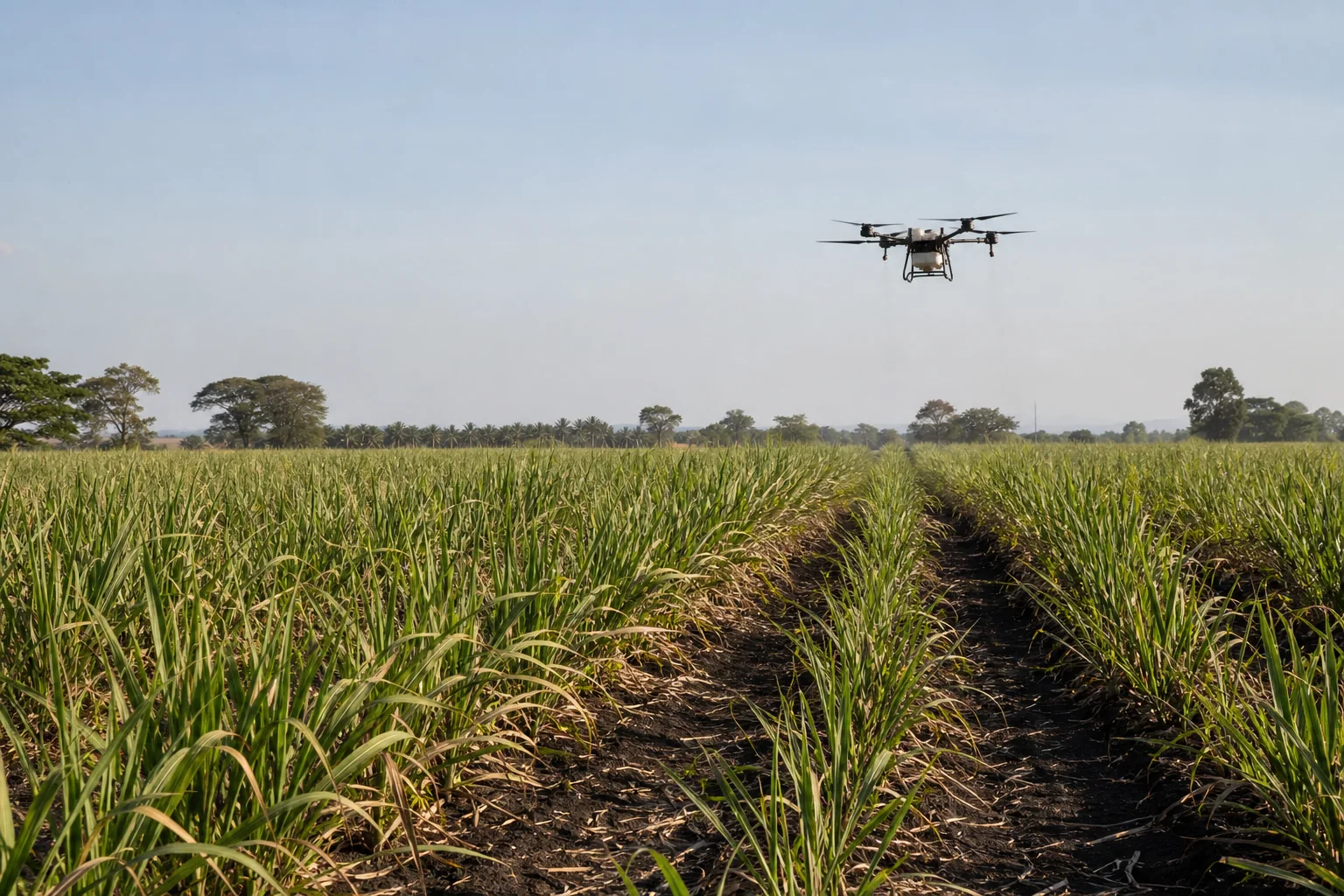
A spray drone is not a small flying boom sprayer. Rotor airflow, flight height, speed, swath, payload and frequent refill cycles create a different application system. Ground sprayers also vary—from compact ATV units to wide self-propelled booms—so equipment specifications and the proposed job matter more than the labels “drone” and “traditional”.
The safest sequence is to confirm that the product and application method are permitted, define the coverage and droplet requirements, assess the site and weather, and only then compare logistics and cost. If drone use is not expressly supported by the current label or relevant authority, operational advantages do not make the application lawful.
Drone spraying vs ground spraying at a glance
| Decision point | Spray drone | Ground sprayer | Question to resolve |
|---|---|---|---|
| Access | Can reach wet, steep, tall-crop or obstructed areas without wheel traffic. | Needs safe vehicle access, clearance and trafficable ground. | Can the whole treatment area be entered without unacceptable risk or damage? |
| Throughput | Narrower swath and small payload create more passes, returns and reloads. | Wide booms and large tanks generally suit high-area broadcast work. | What must be completed inside the available spray window? |
| Carrier volume | Often configured for low carrier volumes, but only where the authorised use supports them. | Can carry higher water volumes where coverage or label directions require them. | What rate, spray quality and coverage does the current label require? |
| Distribution | Rotor airflow can aid penetration, but flight settings and swath interaction can create uneven deposition. | A calibrated boom can provide repeatable nozzle spacing, height and overlap across open terrain. | Has the exact setup been pattern-tested and calibrated? |
| Drift control | Fine droplets, release height, rotor wake and wind interaction require drone-specific assessment. | Coarser spray qualities, lower release height and drift-reduction equipment may be available. | Does the setup meet every droplet, wind, height and buffer condition? |
| Crop and soil contact | No wheel tracks, rutting or direct soil compaction. | Traffic can damage crop or soil, especially when wet or late in the crop. | What is the actual cost of entering this field now? |
| Loading | Small, frequent loads; needs disciplined mixing, battery rotation and a nearby support station. | Larger, less frequent loads; needs bulk-water, pump and vehicle logistics. | Can the loading site contain spills and sustain the planned pace? |
| Regulation | Usually combines aviation, pesticide, operator and sometimes aerial-application permissions. | Established ground-use rules still vary by product, activity and jurisdiction. | Which authority controls each part of this job? |
Coverage and deposition cannot be reduced to one winner
Ground booms usually have an advantage in uniform broadcast coverage because nozzle spacing, boom height and overlap can remain consistent over a wide swath. In a 2025 comparative field study, the tested tractor-mounted system produced higher deposition and lower measured drift than the tested drone. The result supports careful setup comparison; it does not establish a universal ratio for every drone, boom, crop or nozzle. Read the open-access sprayer performance study for its equipment and experimental conditions.
Drones can perform differently inside a canopy. A soybean experiment comparing UAV and ground treatments found that some UAV nozzle treatments deposited more tracer in the upper and lower canopy, while the ground treatment produced greater water-sensitive-paper coverage and larger droplets. That mixed result is exactly why deposition, coverage percentage and biological control should not be treated as interchangeable. See the soybean UAV deposition study.
Flight height, speed, nozzle or atomiser setting, flow, swath and rotor wake interact. Recent crop research also cautions that a setting observed in one canopy or environment may not transfer to another. The guide to spray nozzles and droplet sizes explains why nozzle name alone does not prove the spray quality produced by the complete system.
Lower carrier volume is not automatically lower pesticide use
A drone may carry less water per hectare than a ground sprayer, but the pesticide application rate remains governed by the label or authorisation. Reducing carrier water without confirming the permitted volume and coverage can concentrate the mixture, increase refill complexity, alter deposition and breach directions. Compare litres of carrier mixture, pesticide dose per treated area, number of loads and achieved coverage as separate measures.
Drift risk changes with the complete application system
Drone drift cannot be inferred from GPS accuracy. Off-target movement is affected by droplet spectrum, release height, wind and turbulence, evaporation, rotor airflow, nozzle position, speed and the surrounding terrain or canopy. A 2023 review of UAV deposition and drift research found that operating height, velocity and flow are recurring influences, while methods and results vary substantially between studies. Review the Scientific Reports synthesis of UAV deposition and drift.
Ground spraying is not automatically low drift either. Boom height, pressure, nozzle selection, speed, turns, gusts, temperature, humidity and inversions still matter. Use the guides to spray drift, spraying weather and Delta T as separate decision inputs, then follow the current label and local rules.
Where each method earns its place
💧 Wet or traffic-sensitive field
Drone advantage: reaches the target without rutting or compaction. Confirm that wind, access to a safe loading point and aerial-use permissions still fit.
⛰️ Steep or obstructed terrain
Drone advantage: avoids unsafe vehicle travel. Terrain-following, obstacles, people, livestock and changing wind can make flight planning more demanding.
🌳 Orchard or tall crop
Job-specific: avoiding crop contact may favour a drone, while canopy architecture and coverage requirements may favour a purpose-built airblast or other sprayer.
🎯 Small patch or difficult corner
Drone advantage: targeted mobilisation may avoid taking a large rig across the whole property. Loading, cleaning and flight setup still count toward job time.
🌾 Large, flat broadacre block
Ground advantage: large tanks and wide booms normally reduce refill and pass count where the field is trafficable.
🔁 Mixed property
Combined approach: use the ground sprayer for accessible blocks and assess a drone for authorised wet, steep or late-season sections.
Throughput is more than hectares per flight hour
Drone product sheets often quote theoretical field capacity, while ground-sprayer figures may assume uninterrupted travel. A defensible comparison measures the whole job:
- mapping, risk assessment and setup;
- water supply, mixing and loading;
- turns, obstacles and headlands;
- drone returns, battery changes and charging;
- ground-sprayer travel, tank refills and cleaning;
- weather delays, interruptions and rework; and
- record completion and reporting.
University of Missouri Extension’s drone ownership economics guide and worksheets demonstrate why purchase price alone is insufficient. Their model includes the aircraft, batteries, charger, generator, transport and loading equipment, then spreads costs across assumed annual work. Use local quotes and your measured job times rather than copying another operation’s break-even acreage.
| Cost group | Drone operation | Ground operation |
|---|---|---|
| Capital and setup | Aircraft, batteries, chargers, generator or power, trailer, pumps, tanks, licences and training. | Sprayer and prime mover, guidance, pumps, bulk-water equipment, shed space, licences and training. |
| Operating | Labour, battery life, charging fuel or electricity, parts, calibration, insurance and software. | Labour, fuel, tyres, nozzles, pump and boom maintenance, calibration and insurance. |
| Capacity | Loads, battery cycles, refill time, flight restrictions, support crew and relocation. | Tank loads, road travel, refill time, headlands, soil access and crop clearance. |
| Opportunity | Value of treating inaccessible or time-sensitive areas and avoiding wheel damage. | Value of completing large open areas quickly with established equipment. |
| Failure and exit | Weather grounding, aircraft downtime, battery replacement, parts support and resale. | Breakdowns, soil delays, transport limits, major repairs and resale. |
Drone spraying rules by jurisdiction
Rules change and usually operate in layers. The aircraft regulator may approve a flight while pesticide law still prohibits the application—or the product may permit aerial use while the operator lacks the required aviation or chemical authority. The following guide was reviewed on 1 August 2026 and is a starting point only.
| Jurisdiction | Current starting position | Verify before operating |
|---|---|---|
| USA 🇺🇸 | FAA treats dispensing chemicals and agricultural products as Part 137 work. Its current process distinguishes aircraft below and at or above 55 lb and includes registration, exemptions and agricultural-aircraft operator certification. | Aircraft weight and operation, Part 107 or other pilot requirements, Part 137 certificate and exemptions, current EPA label, applicator licence, state or tribal rules and airspace. |
| Australia 🇦🇺 | CASA aviation requirements depend on the aircraft, operation and whether work occurs under a ReOC. Chemical distribution is also regulated by states and territories; Victoria, for example, has dedicated RPA operator and pilot chemical-rating licences. | RePL/ReOC or excluded-operation conditions, aircraft weight, one-to-many approval, APVMA label or permit, state chemical licences, time and equipment conditions. See the Victoria licensing example. |
| UK 🇬🇧 | HSE currently states that no commercial pesticide authorisations permit drone application. Limited work uses Extrapolated Trials Permits, and every aerial operation requires an Aerial Spraying Permit plus CAA authority. | Product or trials authorisation, HSE application plan and permit, CAA authority, specified operator certification, equipment inspection, notification, buffers and access controls. |
| Canada 🇨🇦 | Health Canada’s June 2026 policy allows RPAS use for products already registered for conventional aerial application when all aerial label directions are followed. Products without aerial use still need an approved label amendment. | Current label and registrant restrictions, application rate, spray volume, droplet and buffer directions, Transport Canada flight rules, provincial or territorial applicator licensing and local requirements. |
| New Zealand 🇳🇿 | CAA guidance says organisations conducting unmanned agricultural dispensing operations must hold a Part 102 operator certificate. Its guidance identifies pilot chemical and unmanned-aircraft agricultural competency alongside non-aviation rules. | Part 102 certificate and privileges, pilot competence, product approval and controls, hazardous-substance qualifications, regional-plan rules, notification and record duties. |
| EU 🇪🇺 | Article 9 of Directive 2009/128/EC requires Member States to prohibit aerial spraying except for special-case derogations meeting stated conditions. A Commission proposal would create a drone-specific route, but a proposal is not current permission. | Current Member State law, derogation or permit, explicit aerial or drone product approval, operator and enterprise certification, aircraft rules, notification and environmental controls. |
Checklist before buying a drone or booking a contractor
- Define the jobs. List crops, targets, field sizes, terrain, seasonal timing and annual treated area.
- Check every product. Confirm whether the current label or authorisation permits the proposed drone, aerial or ground use and carrier volume.
- Map the regulators. Separate aviation, pesticide, applicator, airspace, workplace, environmental and local responsibilities.
- Specify coverage. Define the required spray quality, carrier volume, canopy target, swath and acceptance test.
- Measure the whole job. Include mapping, loading, refills, batteries, travel, cleaning, delays and records—not flight or driving time alone.
- Inspect support logistics. Confirm water, power, charging, pumps, spill containment, PPE, transport and secure chemical storage.
- Run a representative trial. Use water-sensitive papers, tracers or another suitable method under qualified supervision; do not infer coverage from flight-path accuracy.
- Test drift controls. Verify the actual droplet spectrum, release height, wind limits, buffers, nozzle position and shut-off behaviour.
- Compare ownership with contracting. Use local quotes, realistic annual utilisation, downtime, training, insurance, replacement and resale assumptions.
- Plan the record. Decide how the operator, equipment, settings, products, weather, location, treated area, notes and evidence will be captured.
Keep drone and ground application records together
Spraybook can store both drone and boom equipment profiles and preserve an equipment snapshot with each completed spray record. Relevant fields can include:
- drone swath, payload and registration details, or boom width, nozzle spacing and boom height;
- job-specific water rate, speed, droplet size, drone flight height and overlap where relevant;
- location and treated sub-locations, area, operator, products and targets;
- start, middle and end weather observations, notes and up to five photos; and
- CSV exports and eligible PDF reports for review and sharing.
Record creation is mobile-first. Automatic weather, maps, registry lookup and photo upload require network access. Spraybook records the information entered; it does not control a drone, create an as-applied flight map, interpret labels, approve an application or guarantee compliance.
For a wider equipment comparison, read how to choose spray equipment. Use the chemical application record checklist to identify fields and retention duties that may apply.
Published · Updated